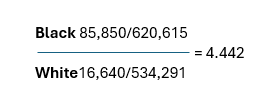
Benchmark 2: Calls for Service by Census Tract
This approach used 1,517,729 calls for service that could be mapped by census tracts. No officer-initiated activities were included in this measure. This approach identified a ratio of 3.2 blacks to whites. Officers in these areas responded to more calls from black residents than white residents in the census tracts.
Benchmark 3: Calls for Service Multiplied by Number of Officers and Call Time by Census Tract
Using data from Benchmark 2, researchers measured the number officers responding to a call and the amount of time (minutes). This provided a better reflection of how many officers and time spent on calls in different census tracts.
Benchmark 4: Priority One Calls from Benchmark 3
Using data estimated in Benchmark 3, researchers identified high priority calls that required emergency responses such as person with a gun, individual screaming, a robbery or burglary in progress. Officers typically focus on these areas as high crime areas
Benchmark 5: Part 1 Violent Crime by Census Tract
Utilizing the census tracts and replacing the calls for service with data on 14,915 reported crimes were linked to census tracts in benchmarks 2, 3, and 4. The ratio of black and white residents in each census tract was multiplied by the reported serious violent crimes.
The last four benchmarks focus on National Incident Based Reporting Statistics to measure characteristics of persons arrested or suspected of a crime.
Benchmark 6: NIBRS Arrestee Data for a Crime
This benchmark calculates the number of arrestees (up to three) who were reported as black or white.
Benchmark 7: NIBRS Suspect Data for All Crime
While benchmark 6 may reflect a bias towards blacks, information on this measurement is sourced from a victim or officer who witnessed the offense. The data was restructured to include offenders who were described by the witness or arrested on a warrant.
Benchmark 8: NIBRS Arrest Data for Violent Crime Only
NIBRS arrestee data from benchmark 6 focused on Murder/Nonnegligent Manslaughter, Negligent Manslaughter, Rape, Robbery, or Aggravated Assault. Of more than 15,000 serious violent offenses, racial data was included for only 3,933 arrests (all races and ethnicities).
Benchmark 9: NIBRS Suspect Data for Violent Crime Only
Data for serious crimes that were filtered from Benchmark 7 provided information on 7,908 suspects (all races and ethnicities).
Researchers reported:
For nearly all the benchmarks, the odds ratio remains indicative of a racial disparity in stops. The metric that is primarily generated by the public are Benchmarks 7 and 9. Relative to all crimes reported to NIBRS and based on racial description of suspects recorded in NIBRS, (Benchmark 7; odds ratio = 1.085). Black people are just 8.5 percent more likely to be stopped than White people. This is a sizable reduction compared to the 344 percent greater rate when the citywide population benchmark is applied (Benchmark 1). When the denominator focuses only on persons arrested for or suspected in serious violence (Benchmarks 8 and 9), the disparity flips.
In the discussion of the study the authors note it is ‘unlikely any benchmark will accurately reflect the range of police activities and satisfy police leaders and critics’. “When considering all of these factors, Benchmark 1 (citywide population) is clearly divorced from the realities of where police officers concentrate their time.”
In their closing statement the researchers note, “Continued use of citywide population rates to measure racial bias in police activities would seem naïve at best, and deliberately misleading if deployed by more informed contributors”.