How do we Reduce
the Risk of Deaths and Injuries from Incidents Involving Police Cars?
Understanding Injury Prevention in the Swedish Context
Summer | 2025
In 1997, Sweden created the “zero vision” policy to reduce the number of persons killed or injured in automobile accidents to zero. The police also adopted the “zero vision” to reduce the officer-involved car crashes. At the time, research of police traffic accidents focused on pursuit-related crashes. The purpose of this study was to determine:
The probability of a police vehicle being involved in a collision.
Identify the causes of collisions.
How to reduce the possibility of deaths and injuries involving police cars.
The study was conducted using data from Vastra Götaland, the second largest county in Sweden. In 2005, the county was composed of 49 cities and 1.5 million citizens. There were 2,800 officers, with 862 of those being sworn. They operated 565 vehicles that included 245 police vehicles and 320 civilian vehicles. During that year, department vehicles travelled 1,310,650 miles. It is important to note Swedish police officers are required to successfully complete comprehensive training program during recruit training as well as additional training every three years.
The first step researchers took was to determine the time officers saved by driving at higher speeds. They refer to this concept as ‘time profit’. To evaluate this, three formulas were used to predict the time savings (profits).
Formula 1 Speed=distance/time
Formula 2 Distance =speed x time
Formula 3 Time = distance/speed.
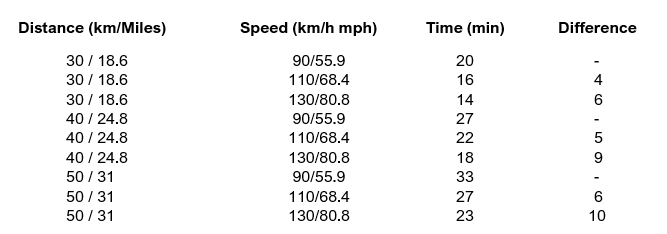
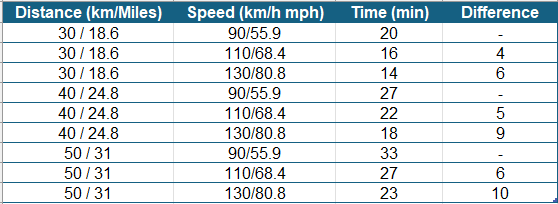
The time savings by travelling at increased speeds were provided for different distances and speeds.[1] It was suggested officers driving at higher speeds oftentimes did not provide any significant improvements in response times when compared with the associated risks.
Priority 2: Pressing intervention required as soon as possible.
Priority 3: Driving, Action deferred.
Priority 4: Driving, No Intervention.
Between 1998 – 2007 there were 2420 collisions involving police vehicles in the county. During this period 48 police drivers and 38 police passengers were injured in collisions with other vehicles. One of these officers died. Twenty-one drivers and 15 passengers were injured in single car accidents, and four were injured in motorcycle incidents.
Officers were severely injured[1] in 18 accidents. Sixty-seven percent (12) occurred in urban areas and the remaining six occurred in rural areas. Severe injuries were attributed to skidding on slippery road services, travelling too fast through urban intersections, and lack of attentiveness. Four accident occurred when officers were operating in Priority Level 1 responses and four were in Priority 2.
The authors suggested deaths and injuries in police vehicle crashes could be reduced by focusing on human factors, vehicle factors, and environmental factors before, during and after collisions. This analysis could be used to analyze and de-brief every incident. They also advocated for the creation of a driver training program similar to firearm training requiring basic competency in basic training and follow-up qualification tests.
To place greater emphasis on preventing police-involved crashes, greater attention should be given to assessing the value of urgent responses and the risk to drivers. To assist with making improved decision making, drivers should use eight questions to improve their risk awareness and responses:
What could happen?
What is the worst that could happen?
How likely is it?
What would you do then?
Can you prevent it from happening?
Can it be made less serious?
Can it be made less likely?
Can the officer handle the situation if it does occur?
In closing, researchers noted the majority of police vehicle collisions could be explained by high speed and their failure to calculate the traffic environment. They also recommended new officers be required to ride with older, experienced officers to gain better insight and guidance on how to operate at higher speeds.
Jörgen Lundälv, Christer Philipson, and Rick Sare, “How do we Reduce the Risk of Deaths and Injuries from Incidents Involving Police Cars/ Understanding Injury Prevention in the Swedish Context”, Police Practice and Research, Vol. 11, No. 5., October 2010, 437-450.